Artist Gary Cook, Vice President of the Royal Institute of Painters in Water Colours, has been in residency on the Thyme estate since Autumn 2025, to record and celebrate the quiet beauty and changing moods of the Water Meadows through the seasons. Here he tells us about the resulting artwork and how it echoes the aims of the Hibbert family’s ongoing conservation project in this space.
1. You’ve spent a year observing the Water Meadows through the seasons. How has your relationship with the landscape changed as you’ve returned to them?
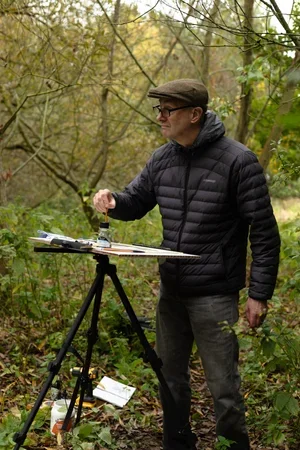
The residency has been such a treat. I live in Dorset and each month over the last year have travelled to Thyme. I try to get there at dawn to catch the best light. After walking the meadows I normally do a quick pencil tonal sketch, then set up my easel and start plein air painting.
There are so many lovely areas at Thyme it's been hard to decide which views to do. There are fewer than 200 crystal-clear chalk streams globally, but we in the UK have 170 of them, which is why painting en plein air next to the River Leach, one of the rarest freshwater habitats on Earth throughout the year, is so inspiring. I'm also drawn to the billowing hedgelines. Where they have been allowed to grow they are magnets to birdlife. Nature prefers a slightly scruffier look, something we modern humans have difficulty in accepting in our ultra-controlled lives. We have the kit to keep hedges neat and trimmed, but the Thyme water meadows are proof that wildlife thrives in a more natural look.
Working mainly in monochrome, I'm drawn to the winter months. I love the skeletal shapes of tree branches and find their structural shapes much easier to capture and I like the winter palette, although plein air painting in the rain is tricky. On one visit I was greeted with a grey, steady, day-long drizzle. Even though the river reeds and watery reflections provided inspiration, the drip, drip, drip made painting difficult. Wet-on-wet is a beautiful recognised technique, but at some stage the paint has to dry. Damp air and rain means the pigment stays fluid on the paper, but with an umbrella and a rechargeable heat gun to dry the watercolour washes, I managed to speed up the drying process.
Summer provides challenges too. At the height of our heatwaves, accompanied only by dragonflies and ducks, I started painting beside the gently flowing chalk stream, having positioned myself in a cool and shady spot beneath a willow. Within an hour, the sun had moved, leaving me and my easel exposed to the full 35 degree heat. I wilted and no doubt looked very uncomfortable. But I couldn't move because my painting wasn't finished, so I adapted. I remembered that I had a large golf umbrella in the car and fetched it. It gave me some shade and I ended up being vaguely pleased with my day's work.
2. Watercolour is particularly suited to capturing light and movement. What is it about the Water Meadows that lends itself to the medium?
Watercolour painting is really a series of barely-controllable mistakes, I can't totally control what happens when the watery paint hits paper. I have to go with the flow, literally, and, happily, my intentions and the paint and H2O's idiosyncrasies often come together to create something pleasing. The paint does pretty much what it wants to do, like the river, and I like the random effects it produces. My problem is that after working for years in a detailed way and often on computer, I find it hard to keep my style loose. The long rigger brushes I predominantly use help, as they're hard to control.
Before becoming a full-time painter 12 years ago, I was an associate editor and the senior artist at The Sunday Times for 26 years. I specialised in articles and graphics that focused on the environment but also worked closely with some of Fleet Street's most renowned reporters including the war correspondent Marie Colvin. We worked closely and often to stressfully tight deadlines.
I covered every major news story during those years including Lockerbie, the Gulf Wars, the death of Princess Diana and the Twin Tower attacks. High-powered journalists have many skills, but organisation is rarely one of them. They would regularly commission diagrams at the last minute. I had to adapt what you would like to produce to what you can realistically deliver in a short time frame. From aiming for 'perfection' to 'good enough' is tricky and sometimes frustrating. But we never missed a deadline. Standing next to this beautiful chalk stream, trying to capture the way the light and water moves is much less stressful. In terms of cooking, I lean heavily towards unfussy, uncomplicated, ingredient-led food that speaks of its components and doesn't get too bogged down in processes.
3. From the flooded winter meadows to the flower-rich summer grasses, was there a particular season or moment which took you by surprise?
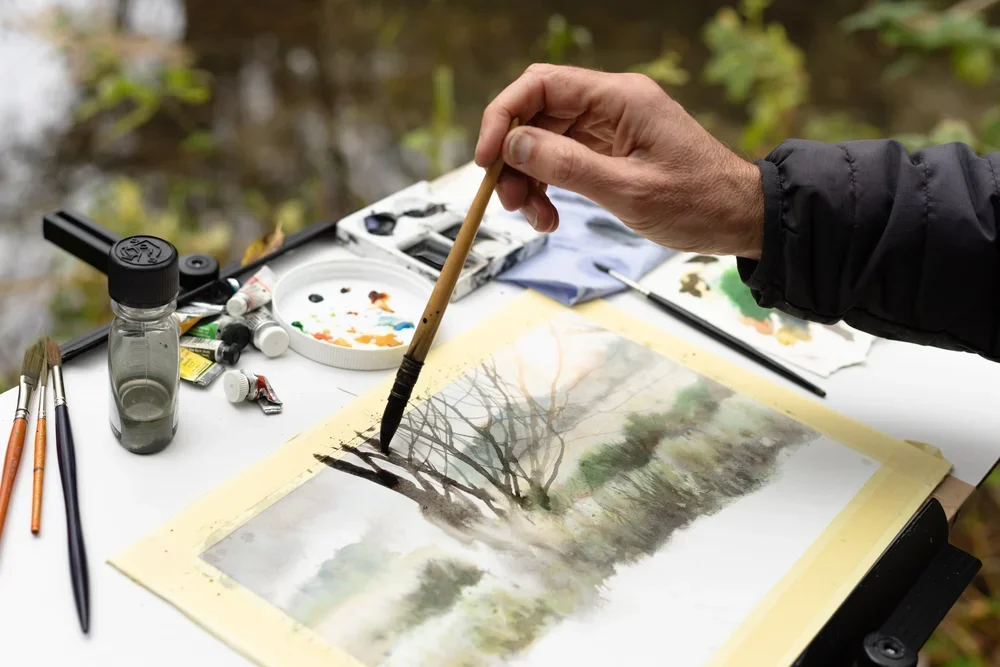
One day in December I arrived from Dorset before dawn and was so lucky in catching the watery winter sun rise over the mist-cloaked fields. A hard hoarfrost sugar-coated the still grasses and the ground was crisp and hard underfoot. I quickly and excitedly assembled my easel trying to capture the scene that I knew was fleeting.
As the watercolour flowed over the textured paper it felt strange; almost sticky. It took me a while to remember that the car had said it was minus three degrees outside. And now I was outside and the penny dropped: the paint was freezing on the surface. But I adapted. Fingerless gloves meant I could control my brushes, while four layers of clothes and a hat kept me warm……ish. The finished (and randomly ice-textured) painting forms part of my Through the Seasons exhibition at Thyme.
After finishing the morning painting, around 1pm I went to the Ox Barn and was generously given lunch. Can you imagine how that feels? I’ve worked hard producing a painting and am then eating day-fresh produce from the kitchen garden I’ve just been standing next to, all prepared by Charlie Hibbert, a Sunday Times columnist and genius chef. Warmed by the award-winning food, I then go back out to the water meadows and start another painting before the light fades.
4. You’ve spoken about the wealth of wildlife you encountered while painting 'en plein air'. Did any particular encounter make its way into your work?
On my first recce of Thyme's water meadows, I fired up my Merlin bird spotting app. I can identify the obvious birdsong but I'm no expert and was amazed that throughout the day, it recorded more than 30 different species. It was uplifting to see how the birdlife has thrived; to hear the evocative call of cuckoos, rare warblers and many varied raptors, it was also the place that I first saw swallows last spring. My standout memory, however, has to be as I was finishing a painting in the winter dusk. I was almost ready to pack up and leave when, out of the corner of my eye, I glimpsed a floating white shape. Seconds later, the estate's Barn Owl silently swooped, just feet above my head. It was very hard to regain my concentration after that.
I combine naturalistic painting and narrative script In my watercolours as a direct result of my newspaper work. After years of covering environmental stories I try to highlight how all of nature is so connected. For example, oak trees provide the habitat for around 2,300 different species from bats to beetles and lichens to mammals. The names and silhouettes of some of these species I have observed on that day while painting are discreetly included in my works.
I love the understated beauty of the Water Meadows. They're not a large area, but even in the 40 acres it is so encouraging to witness that if we treat the land in the right way, with thought and consideration, nature can quickly recover.
5. The wonderful residency is part of Thyme’s wider conservation work in the Water Meadows. What do you hope people might notice about this landscape after seeing it through your paintings?
The thoughtful Thyme team is doing a wonderful job in the meadow restoration that is really bearing fruit. In my watercolours I sometimes also include a silhouette of a moth or butterfly that flitted by. Once people viewing the painting see the writing it opens up the opportunity to talk about the interconnectedness of everything. There are, for example, up to 1,058 different species, from birds to beetles, fungi to lichen dependent on ash trees. Sadly we are predicted to lose 90% of our 70m ash trees to dieback disease. 40 of those species only live on ash trees. I wonder what will happen to all of those interconnected species.
Thyme is setting a brilliant example of how estates, hotels and landowners can make a living, but also care for and restore nature that we're losing. I am so lucky and privileged to have worked in and felt so connected to an area while doing something that I love so much.